
The operating environment for global organizations is becoming increasingly complex and multi-dimensional. To succeed, it is no longer enough to know what your competitors are doing. To succeed in business, organizations need a forward-looking understanding of their market that encompasses competitors, customers, partners, suppliers, regulators, and broader industry trends. AI-driven disruption, intensifying global competition, and rapidly shifting customer behavior, and competitors’ moves behavior have compressed decision windows and raised the cost of being late or uninformed.raised both the speed and stakes of decision-making.
The challenge in making decisions and responding to competitors is not a lack of information – often, it is the opposite, too much information causing “information paralysis” due to an overload of digital information. This is where the importance of a market intelligence program becomes invaluable. Its goal is to cut through this noise to help the organization understand its environment, anticipate competitive moves, detect emerging trends, navigate uncertainty with confidence, and grow profitably.
Through this blog, we aim to break down,
- Define market intelligence
- Importance of market intelligence and its benefits
- How market intelligence is different from market research
- Scope and sources of market intelligence
- How market intelligence helps organizations make smart, data-driven decisions that drive sustainable growth
- How different business functions use market intelligence
- How market intelligence platforms like Contify operationalize market intelligence at scale
What is Market Intelligence?
Market intelligence is a systematic, ongoing process of gathering, analyzing, and interpreting data about market participants (competitors, customers, suppliers), industries, and strategically relevant topics (trends, regulations), and turning it into insights relevant to your organization. It helps organizations understand the dynamics of their business environment, compete effectively within it, and grow. Market intelligence empowers companies to mitigate risks, identify competitive threats, anticipate industry shifts, build robust offerings, and develop strategies for competitive advantage.
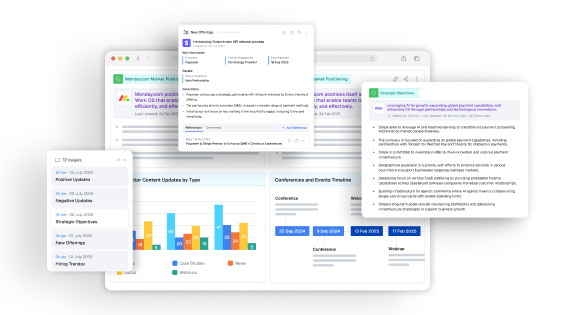
Market intelligence platforms like Contify help process large volumes of information, identify patterns, surface weak signals, and connect related developments across sources and time. It lays a strong foundation for organizations to leverage information, achieve agility, and gain a decisive competitive advantage. Here’s how Contify empowers businesses with business market intelligence to unlock growth:
Importance of Market Intelligence
Market shifts rarely happen all at once. They build quietly over time and can be spotted through weak signals such as shifting customer preferences, competitor moves, or regulatory changes. Market intelligence helps teams catch these signals early, understand their implications, and act before the competitors. It turns discrete updates into coherent and focused insights that guide strategic decision-making, product decisions, go-to-market execution, and sales conversations.
When implemented as an ongoing discipline, it helps teams move faster, reduce uncertainty, and make decisions grounded in real market dynamics. The following areas highlight where market intelligence delivers the most impact across strategy, growth, and execution.
1. Spot Emerging Trends Before They Become Mainstream
Market intelligence solutions help businesses identify shifts in consumer behavior, emerging market trends, industry behavior, and competitor strategies. For instance, early adopters of MI recognized the rise of electric vehicles (EVs) and adjusted their strategy to capture new demand before competitors.
Similarly, many tech startups identified the growing need for AI-powered chatbots through market intelligence software ahead of broader adoption and developed advanced solutions to solve customer problems in real time and gain a competitive edge.
2. Expand into New Markets
By analyzing economic indicators, competitor expansions, and regulatory changes, market intelligence systems help identify potential markets with strong growth potential. This approach enables businesses to expand strategically rather than compete in a saturated market.
For example, insurance firms can use market intelligence to identify customer pain points and develop tailored plans aligned with evolving market needs.
3. Align Product Development with Real-Time Demand
Launching a product based on outdated market intelligence research or partial data can lead to costly missteps. Here, MI ensures businesses align their product roadmaps with current customer needs and competitor strategies, leading to a higher launch success rate.
A Fintech company, for example, can track competitors’ innovations and refine its offerings to improve customer retention and drive new business conversions.
4. Strengthen Competitive Positioning
With a 360-degree view of the market, organizations can benchmark performance, refine their go-to-market strategies, and seize more sales opportunities. A semiconductor manufacturer used strategic market intelligence to increase its sales pipeline by 25% and reduce customer churn by 50% by identifying cross-selling and upselling opportunities.
5. Improve Sales Enablement and Deal Readiness
Market intelligence helps sales teams walk into calls informed. It surfaces competitor pricing moves, new product announcements, customer wins, leadership changes, and partnership news, so sales teams can tailor outreach and handle objections with confidence. It also supports battlecards and account briefs that stay current without constant manual updates.
6. Speed-Up Decision-Making Time across Teams
Market Intelligence enables faster decision making across teams, as when insights are curated, summarized, and delivered in the right format, stakeholders spend less time collecting information and more time acting on it.
To maximize the benefits of market intelligence, businesses must monitor both:
- Quantitative KPIs (e.g., revenue, sales)
- Qualitative KPIs (e.g., customer feedback, survey results)
AI-driven analytics accelerates insights and enables companies to make informed, timely decisions, allowing teams to focus on high-impact updates and act faster with confidence.
The Scope of MI: Looking Beyond the Competitor
A common misconception is that market intelligence is synonymous with “competitor intelligence. Competitor tracking is vital; however, it is only one slice of what a world-class MI program should consist of. The real value of MI lies in monitoring the entire operating environment, not just rival moves. That translates to scanning your entire value chain and the macro forces shaping it, then translating signals into decisions. This broader view is best understood by breaking down the types of market intelligence that together shape a complete picture of your operating environment.
What a broader MI scope should include:
Customer Intelligence
Go beyond what customers say in surveys and track changing preferences, emerging use cases, buying triggers, and switching signals. Understanding these unexpressed needs and your customers’ (and their customers’) buying behaviors is vital, as shifts in their priorities often first show up in your pipeline and product requests.
Supplier Intelligence
Upstream supply chain risk rarely shows up with a clear warning. Monitoring supplier stability, mergers, leadership changes, capacity constraints, and geopolitical exposure helps protect delivery timelines, cost structures, and customer trust, especially when a few vendors are critical to your business. Are your suppliers merging or facing financial stress? This matters for supply chain continuity.
Industry Intelligence
Look at how the industry structure is evolving. Are new entrants changing pricing expectations? Are partnerships reshaping routes to market? Is the value chain consolidating, fragmenting, or shifting? Analyzing the dynamics of the cluster you operate in helps to determine where margins will move next.
Megatrends and Macro Environment
Track the slow shifts that create fast consequences. Identifying shifts in legislation, sustainability trends (e.g., green tech), or economic indicators that will impact your business over the next 3 to 10 years will help leaders make better long-term bets and avoid strategic surprises.
Expanding the scope does not mean monitoring everything. A strong MI program ties coverage to a clear set of decisions, such as:
- Where should we invest next?
- Which markets are becoming riskier or more attractive?
- What will change our customers’ buying criteria?
- Which dependencies could break our delivery or pricing model?
When you broaden the scope with intent, MI stops being reactive firefighting. It becomes proactive strategic planning, helping teams spot risks earlier, act faster, and make decisions with greater confidence.
Sources of Market Intelligence
One of the most practical questions leaders ask is how to gather market intelligence without drowning in data. Effective programs combine multiple sources of market intelligence to see both the big picture and granular details.
The table below provides an overview of the main source types, the data they provide, and how they help.
| Source | Data Type | How it helps |
| Internal Data | In-house data (CRM data, sales performance, product usage logs, win-loss notes) | Turns your data into market intelligence. Reveals which segments convert best, why deals are won or lost, what issues drive churn, and where product usage patterns point to opportunities or risks. |
| External Sources | Intel published outside your organization (industry reports, news, regulatory filings, trade journals, and economic data) | Provides broad context on market size, trends, competitor performance, and regulatory shifts. Faster and cost-effective than starting from scratch, and useful for benchmarking and trend analysis. |
| Digital and social | Online behavior and sentiment (social media posts, forums, reviews, search trends, website analytics) | Shows what customers talk about and how they behave in real time. Captures emerging topics, campaign reaction,s and competitor buzz so you can refine messaging and content quickly. |
| Specialized Sources/ Behavioral signals | Observed actions in the market (pricing changes, new job postings, patent filings, partnerships, trade policy changes) | Indicates what competitors and customers are actually doing, not just saying. For example, a spike in AI-related job postings or patents can signal a strategic shift long before a formal announcement. |
An AI-native market intelligence platform like Contify is designed to aggregate these inputs and deliver structured, decision-ready insights.
Market Intelligence Vs. Market Research
Many confuse market intelligence with market research and often use the two terms interchangeably. While they may appear similar, they serve different purposes. Market intelligence involves gathering and analyzing data on markets, customers, direct competitors, and other market participants, and disseminating it to stakeholders. It is a continuous process focused on “what’s changing, not what currently exists.” Market research is the process of collecting, analyzing, and interpreting data to gain insights into the target market, identify growth opportunities, and make informed business decisions. It helps align various aspects of a business: product development, marketing, and even operational processes, with customer needs and new opportunities.
For example, market research provides a one-time snapshot of consumer preferences or financial trends. However, market intelligence is an ongoing process that provides awareness across the full spectrum. It continuously monitors customer preferences and shares insights that influence a company’s long-term business strategy. Think of market intelligence as your ongoing market radar that keeps you ahead of competitors and industry shifts, while market research gives you precise answers to specific questions; together, they ensure your strategy is both informed and future-proof.
Want a deeper breakdown of how ongoing market intelligence differs from one-off market research projects? Read more in our detailed guide: Market Intelligence vs Market Research – The Elusive Difference
How Different Functions Are Using Market Intelligence
What is market intelligence if not a tool that empowers teams across functions? Today, market intelligence trends show a growing emphasis on personalization, real-time data, and integrated decision-making.
According to a 2023 Gartner survey, 70% of organizations have an MI initiative in place, up from 30% in 2018. Contify, an AI-powered market and competitive intelligence (M&CI) platform, provides the best market intelligence worldwide.
At present, it’s leveraged by 100+ global organizations across diverse industries to not only gather the right insights at the right time, but use them to stay ahead.
Here are examples of how different teams benefit from types of market intelligence:
Marketing Team: Getting A Holistic View
With market intelligence, businesses can analyze all aspects of a market. This data, sourced via business market intelligence tools, helps tailor customer engagement strategies, enabling organizations to gain a deeper understanding of their markets by gathering data in near real-time. For instance, marketers can track individual competitor campaigns and messaging to understand strategies that work well.
According to HubSpot, 96% of buyers research before talking to sales. With a market intelligence system, marketers can align messaging to match customer expectations and behavior.
Sales Teams: Boosting Wins
Without MI, there are often gaps in how and where businesses can market their products. For instance, a company manufacturing semiconductors was on the lookout for new sales opportunities but struggled with performing comprehensive research on its own.
One market intelligence example is a semiconductor firm that leveraged Contify to increase its sales pipeline by 25%. It used competitive market intelligence to identify upsell/cross-sell opportunities, a vital use case of market intelligence software.
Sales battlecards, created using market intelligence research, also help reps position better during pitches.
Battlecards provide concise intel that helps you understand your positioning as compared to your competitors. This is great for identifying gaps and performing market segmentation effectively.
Strategy Team: Gaining Competitive Advantage
What is market intelligence good for at a strategic level? Monitoring competitor website updates, integrations, and patent filings provides valuable insights into their product roadmaps and strategic direction. Analyzing competitor product demos can also reveal new features or capabilities that may be overlooked.
Using tools like market intelligence platforms like Contify, they can track new launches and sources of market intelligence in real-time to plan ahead.
Product Marketing: Making The Difference
With market intelligence, product teams can benchmark features and assess market gaps. For example, Ford responded to Tesla’s EV push by tracking demand signals and aligning its roadmap accordingly, a classic case of strategic market intelligence at work.
Further, you can differentiate your offerings from others in the same space. For instance, Ford has been a well-known name in the automobile industry for over a hundred years. Ford decided to follow suit when another player Tesla was taking up a lot of space with their electric vehicles (EV).
They did this by identifying product development opportunities amidst increasing demand for EVs.
Conclusion
The definition of market intelligence goes beyond data; it’s about deriving real meaning from ever-changing market signals. Businesses can’t ignore the value of market intelligence monitoring in a competitive market.
While implementing it requires investment, the benefits of market intelligence, from faster go-to-market execution to deeper customer understanding, outweigh the costs. With Contify, the transition is seamless.
Ready to power your business with real-time insights?
Explore Contify’s AI-driven platform, the best market intelligence software for modern businesses.
Sign up for a free 7-day trial.
Frequently Asked Questions
How is market intelligence different from marketing intelligence?
Although they often overlap, market intelligence typically focuses on external factors such as competitors, industry shifts, and regulatory changes. Marketing intelligence, a subset of market intelligence, focuses on customer behavior, campaign performance, and buyer journeys. Together, they form a holistic view that supports smarter business and marketing decisions.
What are the sources of market intelligence data?
Sources of market intelligence include news articles, regulatory filings, social media, analyst reports, financial disclosures, customer reviews, surveys, and competitor websites. Platforms like Contify pull these sources together and analyze them to deliver timely, relevant insights.
Why is market intelligence important for strategic decision-making?
Strategic market intelligence helps organizations spot threats early, find new opportunities, and shape long-term strategy. It ensures businesses are not reacting to change, but leading it with the right information at the right time.